
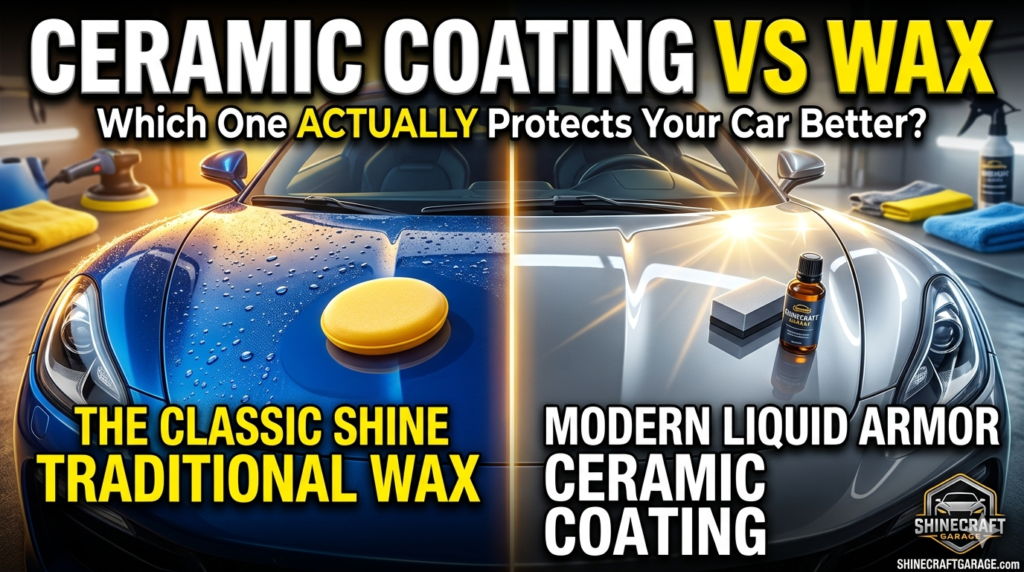
Every car enthusiast knows that exact feeling… But when it comes to real protection, the debate between ceramic coating vs wax comes down to more than just shine. But keeping your car looking like it just rolled out of a showroom takes more than a quick Sunday wash. You need a solid layer of protection against the elements.
For decades, traditional wax was the undisputed king of the driveway. Today, modern ceramic coatings promise years of protection and an unmatched mirror finish.
If you’re trying to figure out where to spend your hard-earned cash and weekend time, let’s break down the real science, the pros and cons, and the honest truth behind Ceramic Coating vs Wax.
Ceramic Coating vs Wax: What’s the Real Difference?
1. Traditional Car Wax: The Time-Tested Classic
When you think of car wax, you’re usually thinking of natural Carnauba (derived from Brazilian palm trees), often blended with beeswax and natural oils. It’s the old-school method we all grew up using.
How It Works
Think of wax as a temporary shield. It sits on top of your car’s clear coat, filling in microscopic valleys and pores in the paint surface. This creates a smooth, flat layer that reflects light beautifully and forces water to bead up.
The Pros:
- That Deep, Warm Glow: Natural wax offers a distinct, rich “wet look” that a lot of classic car owners still swear by. It has a warmth that modern synthetic coatings can’t quite replicate.
- Incredibly Forgiving: Waxing is a great weekend project. If you make a mistake, leave it on a bit too long, or accidentally get it on your trim, it’s highly forgiving and easy to buff out.
- Easy on the Wallet: A solid tub of high-grade carnauba wax is cheap and will last you dozens of applications.
The Cons:
- It Doesn’t Last: Wax is highly sensitive to heat. A standard coat will only last about 4 to 8 weeks before it completely degrades and leaves your paint bare.
- Zero Chemical Resistance: Harsh dish soaps, road salt, heavy automatic car washes, and acid rain will strip a fresh layer of wax almost instantly.
2. Ceramic Coating: The Modern Liquid Armor
Ceramic coatings are liquid polymers formulated from Silicon Dioxide (SiO2) or Titanium Dioxide (TiO2). Essentially, it’s liquid glass in a bottle.
How It Works
Unlike wax, which just rests on the surface, a ceramic coating forms a permanent chemical bond with your vehicle’s factory clear coat. Once it cures, it transforms into a microscopic, ultra-hard layer of quartz-like protection.
The Pros:
- High Longevity: We’re talking years, not weeks. A properly applied and maintained ceramic coating can easily last anywhere from 2 to 5+ years.
- Extreme Hydrophobicity: Water, mud, and road grime don’t just bead—they literally slide right off the surface. This “self-cleaning” effect means your weekly maintenance washes become absolute breeze.
- Chemical and UV Shielding: Ceramic coatings act as a hard barrier against harmful UV rays (stopping your paint from fading or oxidizing) and resist nasty contaminants like bird droppings and tree sap.
The Cons:
- High Upfront Cost: Whether you buy a premium DIY kit or pay a professional detailing shop, the initial investment is significantly higher than a tub of wax.
- The Prep Work is Brutal: You cannot just wipe a ceramic coating on a dirty car. It requires meticulous paint correction (washing, clay barring, and machine polishing) beforehand. Any scratch left behind will be locked under the coating.
- High Spots: If you mess up the application and don’t level the product correctly, it can leave dark, cloudy streaks called “high spots” that can only be removed by machine compounding.
Ceramic Coating vs Wax: The Head-to-Head Comparison
| Feature | Traditional Car Wax | Ceramic Coating |
| Primary Ingredient | Natural Carnauba / Beeswax | Silicon Dioxide (SiO2) |
| How Long It Lasts | 1 – 2 Months | 2 – 5 Years |
| The Shine | Warm, deep, “wet” look | Sharp, glassy, mirror-like gloss |
| Chemical Resistance | Low (Stripped easily) | High (Resists acids & salts) |
| Application Skill | Beginner (Very Easy) | Intermediate to Pro (Requires precision) |
| Cost | Budget-friendly | Premium Investment |
The Final Verdict: Which One Wins?
If we are talking strictly about maximum protection, long-term durability, and defending your paint against the real world, Ceramic Coating is the clear winner. It creates a harder, thicker, and far more resilient barrier that actively repels environmental hazards in a way that wax simply cannot match.
Go with Wax if:
You genuinely enjoy the therapeutic process of detailing your car every month, you own a classic garage-kept car, or you’re working with a tight budget and want an easy DIY project.
Go with Ceramic Coating if:
You drive your car daily through harsh weather, want to protect your vehicle’s resale value for years, and want to make your routine car washes as fast and effortless as possible.
Are you team old-school wax or team ceramic? Drop a comment below and let me know what you’re currently running on your ride!